
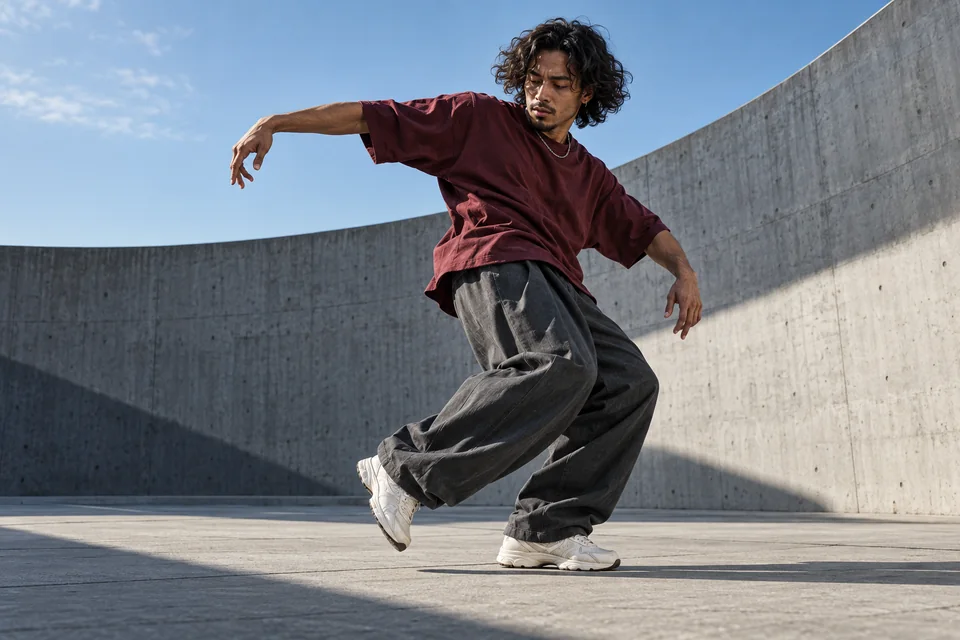
A mirror is helpful, but it is not the only feedback tool. You can build orientation, timing, and body awareness with a reference video, a small recording, and deliberate pauses.
Start with one clear target
First decide whether the reference is facing you or away from you. If it faces you, your visual left may correspond to the teacher’s right. Choose one orientation and keep it for the whole drill. Do not change the view halfway through a phrase.
A useful target is observable. “Be better” is too large for one repetition. “Arrive on the supporting foot before the arm reaches the picture” gives you something to watch and repeat. Choose one phrase, one starting cue, and one ending cue. Keep the source orientation consistent. If you need a mirrored view, decide before the drill begins and write down which side is yours.
A practice method you can repeat
Play a four- or eight-count loop slowly. Watch once, then place the phone where your full body fits and perform without staring at it. Record the attempt. In Dancora, review the reference above your take, pause at the same moments, and compare one checkpoint at a time: feet, torso, then arms. Crop the preview only to keep your body visible; cropping does not change the source file.
On the next pass, remove one support. If you used a slow speed, raise it one step. If you used a count-in, try the entry once without it. If you used a visual reference continuously, look away for the final two counts. These small changes reveal whether you are learning the phrase or only following the screen.
Use Dancora as a practice workspace: import a local video you are allowed to use, set a manual practice range, loop the selected section, and change speed while keeping the original pitch when available. You can flip the practice preview, adjust its crop, use a countdown and rest between rounds, and record a private take for review. Your source media remains separate from the practice settings. If you use on-device iOS beat assistance, treat the result as a local aid that may need listening and manual correction; it is not a guarantee of accurate timing for every full song.
Troubleshoot the part that fails
If you cannot tell whether a shape is correct, use a still pause and describe the body position in plain words. If you lose the sequence, return to the last transition you can name. If the room is small, reduce travel and practice the direction changes in place before restoring the pathway.
When a correction works, test it in context. Extend the loop by a few counts on each side and perform at normal speed. This prevents a perfectly isolated move from becoming disconnected from the phrase. If you are tired, choose a smaller version of the movement and preserve the timing. Rest is part of a repeatable practice plan, not a reward for finishing a long session.
Make the next session obvious
End with a no-screen run if the room is safe. The goal is not to memorize every image immediately; it is to make your body recover the next cue. A short recording gives you evidence that a mirror cannot provide.
You can continue with busy adult practice or use dance video mirroring guide when the next question is about a neighboring skill. Keep the article’s method tied to a real practice decision: where to start, what to repeat, when to change speed, and what evidence to review. That is enough structure to make a phone-based dance session deliberate without pretending that an app can replace your own listening, judgment, or instruction. Extra validation paragraph.
A final check for this specific goal
Before you finish, return to orientation, visual landmarks, and deliberate pauses. Perform one quiet marking pass, one focused repetition, and one complete pass at the fastest speed you can control. Notice the first moment that changes: an early weight shift, a missing pause, a late arm, or a forgotten direction. That moment is more useful than a general verdict. Make one small adjustment, then repeat the complete phrase once. If the change makes the phrase less musical or less stable, restore the earlier version and choose a smaller adjustment. End by recording a plain-language note in your practice history. The note should tell you where to begin next time and what evidence to look for, so the next session starts with a decision rather than a vague intention.